The Committee Can Tell: How Review Boards Are Screening Out Ghostwritten Proposals
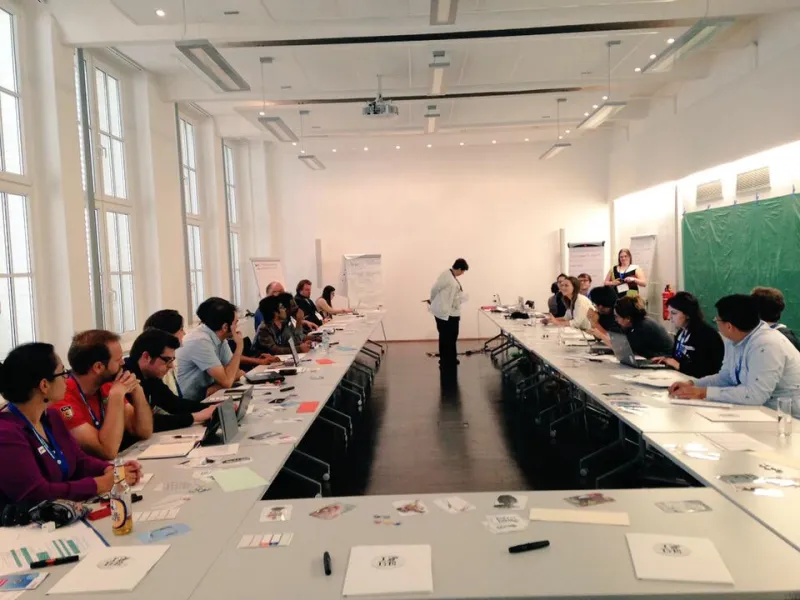
Photo: ProtoplasmaKid, CC0, via Wikimedia Commons
The proposal arrived at 11:47 p.m., four minutes before the deadline. It was grammatically immaculate. Its learning objectives aligned perfectly with ISTE standards. Its title contained the phrase "empowering learner-centered ecosystems."
The reviewer who opened it — a district instructional technology coordinator from Ohio who has scored proposals for three national conferences — flagged it within ninety seconds. Not because it was bad. Because it was flawless in a way no first-time submitter's proposal ever is.
"I've read hundreds of proposals from real classroom teachers," she told us, speaking on condition of anonymity because she still serves on the committee. "Real teachers write about real friction. They mention the unit that flopped. They admit the rollout was messy. This one read like a brochure for teaching in general."
She scored it low. Whether it was written by a human, she'll never know for certain. But the encounter reflects a shift now rippling through every conference review committee in American edtech: the arrival of submissions that are polished, generic, and increasingly suspected of being machine-written.
The Floodgates Open
Conference organizers have always dealt with uneven proposal quality. What's new is the uniformity of the problem. Several program chairs we spoke with report the same pattern: a spike in submissions during the final 48 hours of a deadline window, a noticeable rise in templated language, and abstracts that promise everything — AI integration, equity, data privacy, engagement — while describing no specific classroom, student, or result.
The economics are simple. Generative tools have collapsed the cost of producing a plausible proposal to nearly zero. For vendors, consultants, and even well-meaning educators, submitting ten AI-drafted proposals now takes less effort than carefully writing one. Review committees, meanwhile, still operate on volunteer labor and fixed scoring windows.
The result is a bottleneck — and a trust problem. When a committee cannot tell whether a speaker genuinely did the work described, the entire value of the program comes into question. Conferences trade on credibility. Attendees who sit through a session that turns out to be a repackaged webinar feel cheated, and they remember it the following year when registration opens.
What Reviewers Are Doing About It
Committees are adapting, though slowly and with real reluctance. A few practices are emerging across the field:
Requiring specifics up front. Many rubrics now demand named tools, grade levels, sample sizes, or district contexts in the abstract itself. Vague proposals lose points automatically. AI-generated text tends to generalize; lived experience tends to specify.
Asking for artifacts. Some conferences now request a short supplementary upload — a slide from the actual deck, a student work sample with identifiers removed, a link to the pilot's summary. It's a lightweight verification step that machines can't easily fake.
The video-or-voice check. A growing number of programs ask shortlisted submitters to record a two-minute explanation of their session, unscripted. Reviewers aren't grading production quality. They're listening for whether the speaker can talk about their own work without a script.
Weighting reflection over polish. Several committees have quietly revised rubrics to reward candid descriptions of failure and iteration. Ironically, this penalizes the very perfection AI produces — a deliberate recalibration.
Not everyone is comfortable with these measures. One program chair admitted her committee considered AI-detection tools and rejected them, citing unreliability and the risk of falsely accusing a nervous first-time submitter. "We'd rather design a process that surfaces the real than one that punishes the suspected," she said.
The Honest Middle Ground
Here's what deserves saying plainly: banning AI from the proposal process is neither possible nor wise. Many educators — especially those juggling full teaching loads, or writing in a second language — use these tools as editors, brainstormers, or grammar checkers. That's not deception. That's a workflow.
The line the field is drawing is between assistance and authorship. A proposal drafted by a machine and submitted without human reflection is a problem. A proposal grounded in genuine practice, then refined with AI help, is indistinguishable in spirit from the teacher who runs a draft past a colleague.
We asked submitters who use AI openly how they navigate this. A middle school science teacher in Georgia who presented at a regional STEM conference last spring put it this way: "I used a chatbot to tighten my abstract and check my objectives made sense. But every example in that session came from my own classroom, because that's the only thing I actually know. If you don't have that, you don't have a session."
Guidance for Educators Planning to Submit
For educators eyeing next season's conference cycle, the practical advice converges on a few points:
- Lead with your evidence. One concrete result from your own building outweighs a page of framework language.
- Name your context. District size, student population, subject, constraints — specificity is the strongest authenticity signal available.
- Use AI as an editor, not an author. Draft from your own experience first. Then use tools to tighten, restructure, or pressure-test clarity.
- Disclose where it matters. If a conference asks directly, answer honestly. Increasingly, transparency is treated as a credibility marker, not a confession.
- Be ready to speak unscripted. If your proposal advances, assume someone will ask you to talk about it live. Make sure you can.
The Stakes Beyond the Scoring Room
There's a broader principle at work. Conferences exist to move knowledge between practitioners — from the teacher who solved a problem to the teacher still facing it. That transmission depends on the audience trusting that the person at the front of the room actually lived what they're describing.
Generative AI hasn't broken that trust, but it has raised the price of earning it. The committees adapting their rubrics, the submitters grounding their abstracts in real classrooms, the reviewers learning to read for friction rather than polish — all of them are doing the same thing: reasserting that expertise is something you accumulate, not something you generate.
The proposals that will win rooms next year won't be the ones the machines wrote best. They'll be the ones only one person in the country could have written.