The Best of Both Rooms: Sorting Pandemic-Era Conference Innovations From Costly Compromises
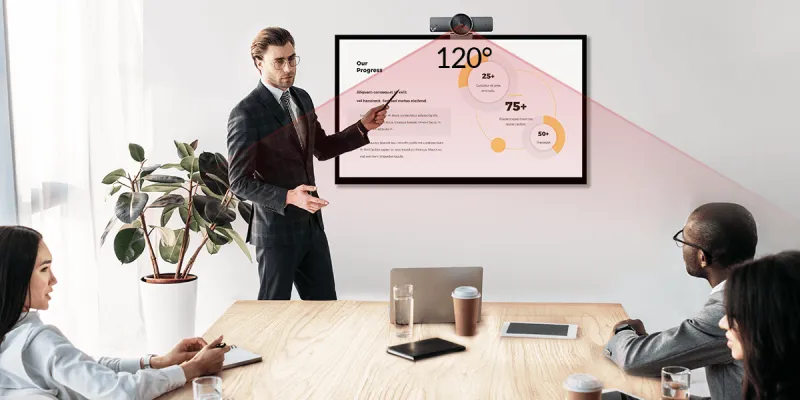
Photo: hybrid conference presenter speaking to camera with laptop audience on screen, via www.avaccess.com
There was a moment in 2021 when it seemed plausible that hybrid conferences were the future: the reach of the internet married to the energy of a hotel ballroom. Nearly half a decade later, the verdict from educators is less enthusiastic. Ask around at any major US EdTech gathering — ISTE, FETC, SXSW EDU — and you will hear a familiar refrain. Virtual attendees feel like an afterthought. In-person attendees wonder why sessions feel thinner, why speakers seem distracted, and why the whole enterprise costs as much as it did before anyone had ever heard of a webinar fatigue.
The problem is not hybrid itself. The problem is that many organizations adopted hybrid as a compromise rather than a design choice. Before we abandon the model entirely, it is worth separating the genuinely valuable innovations of the pandemic years from the compromises that are quietly hollowing out the conference experience.
What Earned a Permanent Place
Start with captions. Live captioning and accurate session transcripts were once treated as a compliance afterthought, available only on request with weeks of notice. The pivot to virtual forced nearly every event platform to integrate real-time captioning, and the results have been transformative well beyond the deaf and hard-of-hearing community. Non-native English speakers, attendees following along on a phone in a noisy hallway, anyone reviewing a dense research presentation afterward — captions improved the experience for a striking share of participants. Any conference that quietly drops captioning now is cutting a feature that costs little and serves many.
Recorded keynotes are the second keeper. Before 2020, the idea that a keynote might be available after the fact seemed to threaten ticket value. In practice, the opposite proved true. Educators who attended in person routinely revisited recordings to take better notes; those who could not attend found a legitimate on-ramp to next year's registration. Recording major sessions costs money, but it extends the life of the content for months and gives districts a concrete artifact to justify professional development spending.
The third innovation worth keeping is flexible pricing. Tiered access — a virtual pass for those without travel budgets, day passes for local educators, full registration for the committed — opened doors for classroom teachers who have long been priced out of the conference circuit. Given that most US teachers still pay for a meaningful share of their own professional development out of pocket, this is not a nicety. It is a matter of who gets to participate in the conversation shaping their profession.
What Quietly Drains the Value
Now for the compromises. The most damaging is the camera-in-the-back-of-the-room model: a virtual attendee staring at a wide shot of a panel they cannot hear, unable to see slides, unable to ask a question that anyone in the room acknowledges. This is not hybrid. It is a surveillance feed, and it tells remote participants exactly how much they are valued. If an organization cannot afford dedicated moderation, remote-specific cameras, and a facilitator who reads chat questions aloud, it should not sell virtual passes at all.
The second drain is speaker dilution. Hybrid formats were supposed to broaden the speaker pool by removing travel barriers — and in the best cases, they did. But too often the result is a program padded with remote presentations that were never designed for a mixed audience: presenters reading a script to a camera while a live room waits for the next session. A strong hybrid program curates deliberately. Some sessions are built for the room. Some are built for the stream. Very few genuinely serve both, and pretending otherwise serves no one.
Finally, there is the scheduling mush. The pandemic normalized on-demand everything, and some conferences responded by scattering sessions across recorded archives, live streams, and in-person slots with no coherent structure. Attendees spend more time decoding the schedule than learning from it. Clarity — a plain statement of what is live, what is recorded, and what is room-only — costs nothing and respects everyone's time.
The Standard Worth Holding
The lesson of the past several years is not that hybrid failed. It is that hybrid done cheaply fails, and hybrid done thoughtfully can widen access in ways the industry spent decades failing to achieve. A captioned session, a recorded keynote, and an honest virtual tier are not pandemic relics. They are baseline expectations for an events industry that claims to serve educators.
Conferences that treat remote attendees as full participants — with moderated Q&A, dedicated production, and pricing that reflects the actual experience — will build loyalty that outlasts any format debate. Those that treat the virtual pass as found money while delivering a webcam feed will keep hearing the same complaint, year after year, until the remote audience simply stops logging in.
The technology is not the barrier anymore. It never really was. The question for every conference organizer planning their next event is simpler and harder: who, exactly, are you building this for?