The Quiet Corner That Outperforms the Ballroom: A Case for Taking Poster Sessions Seriously

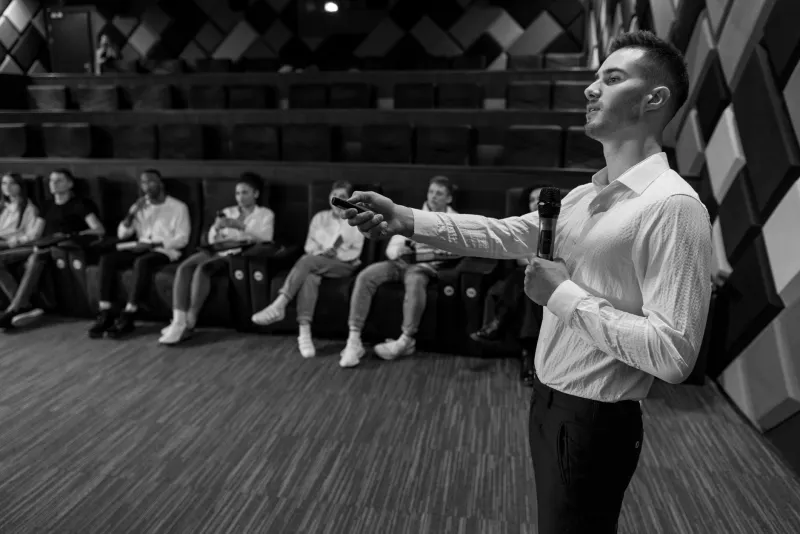
Photo by Photo by Marwen Larafa on Unsplash on Unsplash
Walk the floor of any major education conference in the United States — ISTE, FETC, your regional state association gathering — and you will notice a pattern. The largest rooms go to the keynotes. The next largest go to the featured speakers with publisher sponsorships. And somewhere between the restrooms and the loading dock, you will find a row of foam boards attended by a handful of people who seem oddly relaxed.
That relaxed corner is the poster session, and it may be the most underutilized format in professional learning today.
The Math Nobody Runs
Consider the arithmetic of a typical breakout session. One presenter, sixty minutes, two hundred attendees, forty slides. Each participant gets, at best, a question at the end — usually filtered through a roving microphone. The conversation-to-content ratio is heavily tilted toward broadcast.
Now consider a poster session. A presenter stands beside their work for ninety minutes. Attendees drift up one or two at a time. The exchange is conversational, adaptive, and specific to the person asking. Nobody is rushing to the next slide. Nobody is managing a room.
For practitioners who want genuine dialogue rather than delivery, the poster hall is, quite simply, the highest-value real estate in the building. The irony is that organizers treat it as filler.
Three Conversations That Went Somewhere
The case for posters is best made by what happens after them.
The district pilot. A middle school science coordinator from Ohio presented a small poster on using open-source analytics dashboards to flag chronic absenteeism. A assistant superintendent from a neighboring state lingered for twenty minutes — longer than she would have dared hold the floor in a breakout session. Six months later, her district was running a pilot of the same dashboard, with the original presenter consulting. The contract was signed because of a hallway conversation, not a procurement fair.
The co-authored paper. A doctoral candidate presenting preliminary findings on AI-assisted feedback in composition courses was approached by a community college instructor wrestling with the identical question. They exchanged contact information, compared classroom data over the following semester, and eventually published together in a peer-reviewed journal. Neither was looking for a collaborator. The format simply made the introduction unavoidable.
The career pivot. A classroom teacher with no institutional affiliation presented a modest poster on a peer-mentoring structure she had built from scratch. A nonprofit program director happened by, asked questions no interview panel had ever asked her, and encouraged her to apply for an open instructional design role. She made the leap that fall. She still describes the poster session as "the first time anyone treated me as a researcher."
Three different outcomes, one common thread: the poster format created the conditions for depth that larger sessions structurally cannot.
Why Organizers Bury Their Best Asset
The marginalization of poster sessions is not accidental. It reflects three assumptions that deserve scrutiny.
First, posters are perceived as junior. Early-career academics and graduate students dominate the format, so organizers conclude the content is preliminary. But preliminary is precisely what many attendees need — a window into work that is still malleable, where feedback can actually shape the outcome.
Second, posters are hard to evaluate in advance. A keynote has a name; a poster has a title and an abstract. Scheduling committees default to star power. Yet anyone who has sat through a disappointing big-name session knows that recognition and relevance are not the same variable.
Third, the format lacks spectacle. There is no stage, no lighting design, no applause. In an era when conferences compete on experience, quiet competence is a hard sell to marketing departments. It is nevertheless a strong sell to the educators who attend.
What a Serious Poster Program Would Look Like
If conference organizers took the format as seriously as attendees implicitly do, several changes would follow.
Location matters. Move poster sessions off the basement level and into the main thoroughfare — the route everyone already walks between keynotes and coffee. Foot traffic is the format's oxygen.
Schedule deliberately. Do not run posters opposite the marquee breakout sessions. Give the hall a protected window, and staff it with a host whose job is to make introductions between presenters and passersby with shared interests.
Extend the lifecycle. Pair each poster with a digital artifact — a one-page summary, a short recorded walkthrough, a follow-up virtual session a month later. The conversation should not end when the boards come down.
Recognize the work. A modest award, judged by practitioners rather than academics alone, signals that poster presentations are a destination, not a consolation prize. It also gives program committees a reason to promote the session in the main program rather than a footnote.
An Invitation to Attendees
The argument here is not only for organizers. Attendees bear responsibility too. The next time you find yourself drifting past a row of posters because the ballroom session starts in forty minutes, stop. Ask the presenter what surprised them. Ask what failed. Ask what they would do differently.
You may walk away with nothing more than an interesting idea. Or you may walk away with a pilot, a co-author, or a new career — outcomes that no keynote, however brilliant, has ever handed anyone from the stage.
The quiet corner of the conference hall has been doing its work patiently for decades. It is time the rest of the profession noticed.